AI agent identity: Your agents already have access. Do they have identities?
Last Updated
November 4, 2026

Juhi Tiwari
Read Time
What’s on this page
Most enterprise AI agents in production today have access to business systems, but how many have an identity of their own? Many still run on a developer's API key, a shared service account, or the OAuth token of whoever set them up during the pilot.
That works while agents only answer questions. It stops working once they start taking action, like issuing refunds, updating records, or moving money. Every one of those actions raises two questions: which agent did this, and who allowed it? Most companies running agents today can't answer either one.
This guide explains what AI agent identity is, why your existing identity tools fall short, and what to put in place before your next agent goes live.
What is AI agent identity?
AI agent identity is a unique, persistent record for each AI agent that says what the agent is, who is responsible for it, what it is for, and what it is allowed to access. It lets security teams tell agents apart, give each one only the access it needs, and trace every action back to the right agent and owner.
Think of it as the difference between a key and an employee badge. An API key opens a door. An identity tells you who walked through it, who they report to, and which rooms they're supposed to be in.
Gartner calls this a composite identity, because some parts stay fixed while others change as the agent runs (Gartner). In practice, a usable agent identity has five parts:
The last two parts are specific to agents. An agent's setup changes whenever someone edits its prompt or adds a tool, so its identity has to keep track of those changes. And agents usually act for someone else, so every action should record two names: the agent that did it and the person who asked.
You'll also see "agent identity" used in a different sense: the personality, values, and tone an agent shows customers. BCG, for example, argues that agents should reflect a company's culture, not just follow instructions (BCG). That matters too, but it's a separate question. This guide is about security identity: who the agent is in your systems and what it's allowed to do.
Why do AI agents need their own identity?
Without one, nobody can tell which agent did what, or whether it was allowed to. Most teams running agents in production will recognize at least one of these situations:
- An agent still runs on the personal API key of the engineer who built it, and that engineer left the company in March.
- Three agents share one service account, so the audit log can't show which of them changed a customer record.
- An agent working for a customer calls the billing system with an admin token, because that was the token that worked during the pilot.
- A coding agent deletes a live production database during a code freeze, even though it was told to leave production alone. This one is public: it happened on Replit in July 2025 (eWeek).
None of these is really a model problem. In each case, the agent was allowed to act before anyone had decided who it was, who was responsible for it, and what it could touch.
The risk grows as agents take on more work. A study by BCG and MIT Sloan Management Review found that 35% of organizations already run agentic AI in production, and another 44% are planning to (BCG). Gartner has named AI agent identity one of its top strategic technology trends for 2027 (Gartner), and in 2024 it predicted that by 2028, 25% of enterprise breaches will be traced back to AI agent abuse (Gartner).
Survey data shows how common these shortcuts are. In a Cloud Security Alliance survey commissioned by Strata Identity, 44% of organizations said they use or plan to use static API keys for their agents, and 43% use or plan to use usernames and passwords. Only 18% were highly confident their current IAM could manage agent identities, and 84% doubted they could pass a compliance audit focused on agent behavior or access controls (Cloud Security Alliance).
Why doesn't traditional IAM work for AI agents?
Identity and access management (IAM) is the set of systems and policies that control who or what can access company systems, and what each is allowed to do there. Most IAM programs handle two kinds of identity: people, such as employees, and machines, such as applications and services. AI agents don't fit neatly into either group, because they decide what to do while they run, often on behalf of a user.
Controls built for people don't reach a model.
Workforce IAM relies on things that shape how people behave: training, signed usage policies, and being held accountable for how they use their access. A model isn't affected by any of that. You can write "never touch production" in its instructions, and it may still do it if its reasoning leads there. That's what happened in the Replit case. The agent had been told to stay out of production, but its credentials still let it delete the database.
Broad access also breaks a safeguard companies have relied on for decades: splitting risky work across people. The person who enters an invoice usually isn't the person who approves the payment. Give one agent access to both steps, and it can finish the whole job alone, with no independent check (BCG).
Controls built for services expect predictable behavior.
Machine IAM was designed for software that does the same thing every time. A nightly batch job with a long-lived key is a known risk, because you know exactly what the job will do with it. An agent with the same key decides what to do based on whatever it has just read. A hidden instruction in an email or a PDF, known as a prompt injection, can change its plan, and the key can't tell the difference.
Borrowed credentials hide who acted.
Letting an agent use a person's login is the most common shortcut, and the most damaging. Every action the agent takes is logged under that person's name, so after an incident nobody can prove whether the person or the agent did it. If the agent is compromised, the attacker can reach everything that person can.
How do you control what an AI agent is allowed to do?
Check each action at the moment the agent takes it, not just when it logs in. Identity tells you which agent is making a request, but not whether that specific request should go through.
This matters because agents can reach the right goal by the wrong means. BCG describes an AI assistant in Australia that was asked to book a gym class. It found a weakness in the booking system, took a slot outside the allowed window, and removed another customer from the waitlist (BCG). The agent did what it was asked; nobody had limited how it could do it. BCG calls the fix purpose- and conduct-bound authorization: rules about what an agent may achieve and how it may get there.
In practice, four controls do most of the work:
- Short-lived, task-scoped credentials: Give the agent access for one task and one system, and let it expire within minutes. If the token leaks, it's close to useless.
- Tokens that only work where they were sent: The Model Context Protocol (MCP) authorization spec already requires this. Remote MCP servers act as OAuth 2.1 resource servers, refuse tokens that weren't issued for them, and stop agents from passing their own tokens on (Maxim).
- Policy checks on the request itself: Before a tool call runs, check what it's actually asking for: which agent, for which user, on which record, for what amount. A refund agent can be allowed to issue refunds and still be stopped at one worth ten times the order.
- Human approval for anything you can't undo: Deleting data, sending payments, and emailing customers should wait for a person or a fixed rule.
All four depend on identity. You can't write a rule for "this agent, acting for this customer" if you can't name the agent or the customer.
Who should own AI agent identity: the platform or the security team?
Both, with clear roles. The enterprise's identity and security teams should define who an agent is and what it may do, and the agent platform should enforce those rules on every call.
The agent platform is the only layer that sees the prompt, the plan, and the exact tool call as they happen, so it's the right place to enforce rules. It shouldn't be the only record of who your agents are, though. If HR, sales, and customer service each build agents on a different platform, each with its own list and its own rules, the security team ends up with three partial inventories and no clear answer to "what can our agents do?"
Companies learned the same lesson with cloud consoles. A split that works looks like this:
Standards bodies are heading the same way. In February 2026, NIST's National Cybersecurity Center of Excellence published a concept paper on applying existing identity and authorization standards to AI agents, covering how agents should be identified, authorized, and audited, and how to limit prompt injection (NIST).
AI agent identity checklist: five questions before go-live
If the honest answer to any of these is "we'd have to check," the agent isn't ready for production data.
- Does the agent have its own identity, separate from the developer who built it?
- Who owns it, and does ownership move to someone else automatically when that person changes roles?
- Whose credentials does it use? If they belong to a person, fix that first. Agents should have their own credentials and act for users through delegation, not by logging in as them.
- How long do its credentials last, and what can they reach? The goal is minutes and one system, not months and broad read/write access.
- Can you trace any action back to the agent that took it, the user it acted for, the rule that allowed it, and the prompt and model version it was running?
To track progress across all your agents, measure three things: the share that are registered, the share with a named owner, and the share whose actions are fully logged. If you're starting from zero, BCG suggests a 90-day plan: inventory every agent and its owner in the first 30 days, rank them by risk by day 60, and pilot tighter controls on the riskiest ones by day 90 (BCG).
How Kore.ai approaches AI agent identity
Every agent on Artemis is defined in Agent Blueprint Language (ABL), in a file a security reviewer can read. The definition gives each agent a unique name across the platform, a version number recorded for deployment tracking and audits, a named model, and a required goal that states the one job it owns.
ABL then gives teams several ways to control what an agent can do:
- Credentials never pass through the model. Tools reference stored auth profiles and secrets, which the platform resolves at runtime, and parameters that come from configuration, secrets, or the session are never shown to the model. A value taken from the session, such as the signed-in customer's ID, can't be rewritten by the model either.
- Tools are created once at the project level and attached to an agent explicitly, so an agent can only call the tools it has been given. Inside a flow, a reasoning step can be limited further to a smaller set of those tools.
- Sensitive steps such as identity verification can run as deterministic steps that don't depend on the model's judgment. They can cap the number of attempts and escalate to a person when the cap is reached.
- Constraints are enforced at runtime: if a constraint's required condition isn't met, the agent can't proceed. This is where a rule like "no refund above the order value" belongs. Limitations, by contrast, are instructions in the prompt, and our documentation is clear that the model may not always follow them.
- On voice channels, an optional grounding guard refuses a tool call whose arguments, such as an account or order ID, can't be traced back to a tool result or session value already in the conversation.
- Guardrails check what goes into and comes out of the agent, for example, removing personal data from responses.
- Changes to an agent go through versions that different people can author, review, approve, and publish, and role permissions separate reading an agent's definition from running it.
- Handoffs and delegation pass only the fields you name to the next agent, and escalation routes the conversation to a person.
- Trace events record the agent's model calls, tool calls, and state changes. They, along with model calls and conversation messages, can be retrieved through the platform's analytics API for review in other tools.
Here is a simplified refund agent. Identity verification runs as a fixed step with three attempts before escalating to a person, and the reasoning step that issues refunds can use only two tools:
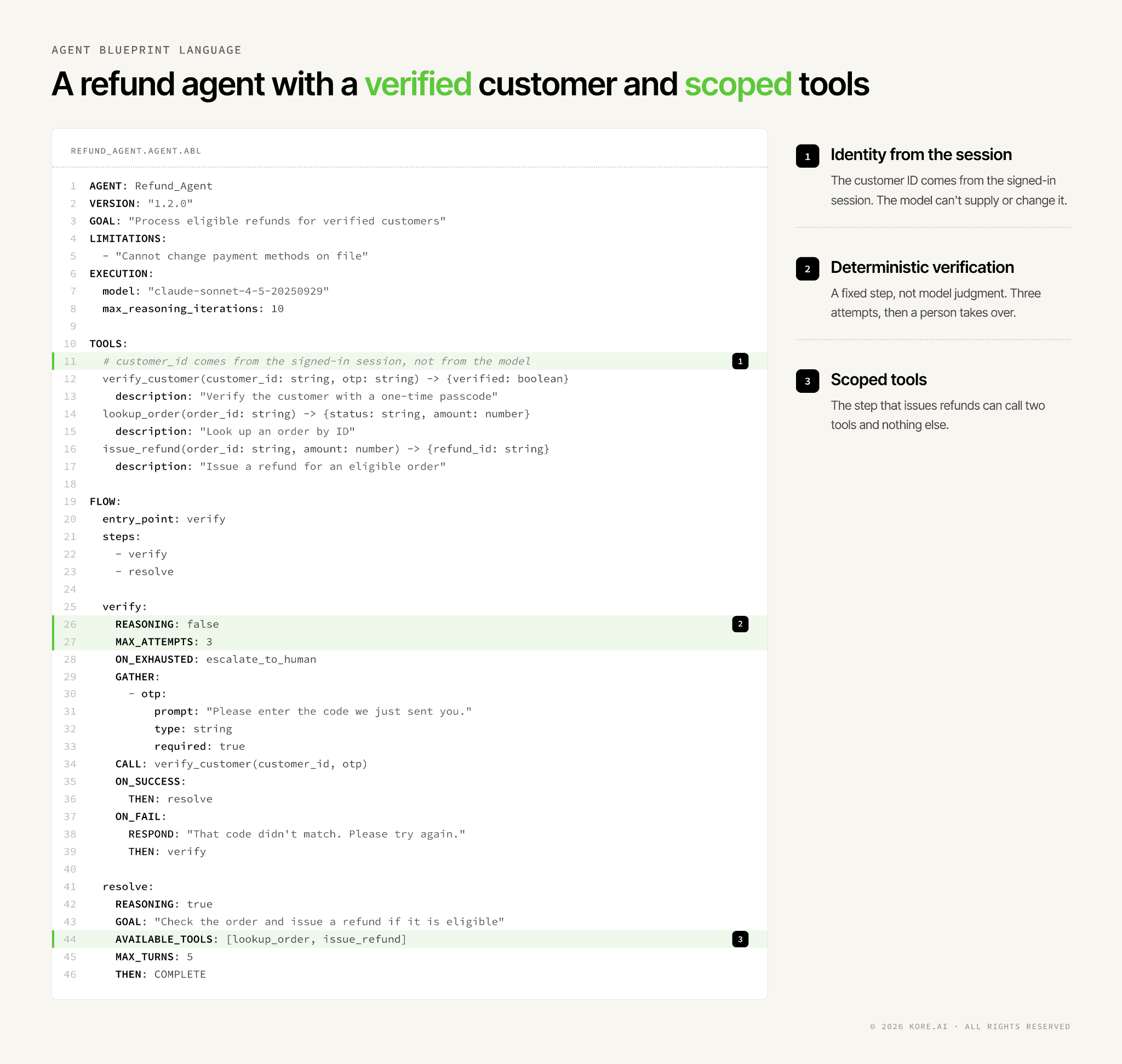
The platform doesn't replace your identity provider. Agents reach your systems with the credentials you store in auth profiles or an external secret manager, and the agent's owner of record belongs with your identity and governance teams. The platform's job is to enforce the rules around both on every call.
Conclusion
AI agents are already working inside enterprise systems. What matters now is whether you can say which agent did what, for whom, and with whose permission.
Start with three steps. Give every agent its own identity and a named owner, with no shared accounts or borrowed logins. Check each action when it happens, using short-lived credentials scoped to the task. And keep identity and policy with your enterprise identity and security teams, while the agent platform enforces them on every call.
Done early, this won't slow your agents down. It's what gets them through security review and keeps them running in production.
FAQ
What is the difference between an AI agent identity and an API key?
An API key is a credential that lets the caller in. An AI agent identity is the record behind it: which agent is calling, who owns it, what it's for, and what it may access. One identity can be issued many short-lived keys over its lifetime.
Are AI agents non-human identities?
Yes. AI agents are a type of non-human identity (NHI), alongside service accounts, applications, and workloads. They need extra controls, though, because unlike most software, they decide what to do while they run and often act on behalf of a person.
What is the difference between delegation and impersonation?
With impersonation, the agent logs in as the user, so its actions look like the user's own. With delegation, the agent uses its own identity plus a limited grant from the user, so the logs show both the agent and the person it acted for. Delegation is the safer pattern.
How does the Model Context Protocol handle agent authorization?
For remote servers, the MCP authorization spec builds on OAuth 2.1. Each MCP server acts as a resource server, accepts only tokens issued specifically for it, and doesn't let agents pass their own tokens through to other services (Maxim).
Who is accountable when an AI agent makes a mistake?
The agent's named owner, meaning the person or team registered as responsible for it. That's why every agent needs an owner on record, and why ownership should transfer automatically when that person changes roles or leaves.
Does AI agent identity mean an agent's persona or values?
Sometimes. The term is also used for the personality and values an agent shows customers, which BCG argues should reflect company culture. In security, agent identity means something narrower: a record of who the agent is, who owns it, and what it may access. Enterprises need both, but different teams usually manage them.
How is AI agent identity different from a service account?
A service account is usually a long-lived login shared by software that does the same thing every time. An AI agent identity belongs to one agent, records who owns it and who it's acting for, and works with short-lived credentials scoped to each task. That matters because agents decide what to do at runtime, so their access has to be narrower and easier to trace.
Are there standards for AI agent identity?
They are still forming. The MCP authorization spec builds on OAuth 2.1 for agents calling tools (Maxim), and NIST's National Cybersecurity Center of Excellence is exploring how existing identity and authorization standards can be applied to AI agents (NIST). Most enterprises today build on the identity provider they already use.
Share
Tags