Agentic commerce: what happens to customer service when AI agents do the buying
Last Updated
November 4, 2026

Juhi Tiwari
Read Time
What’s on this page
When an AI agent's purchase goes wrong, shoppers may blame the AI platform. But the merchant still has to handle the compliant
In February 2025, Geoffrey Fowler, a tech columnist at The Washington Post, asked OpenAI's Operator agent to find the cheapest eggs available for delivery. Instead, the agent placed an order through Instacart without his confirmation. What started as a $13.19 purchase ended up costing $31.43 with fees and a tip. Fowler only discovered the purchase through a credit card alert. While OpenAI acknowledged that Operator had failed to follow its safeguards, the purchase had already gone through Instacart. Any issue with the order or a refund would still need to be addressed through the purchase and payment process. (Washington Post, via ADN).
OpenAI owned the mistake. Operator, it said, "made a mistake and fell short of its safeguards." But an apology from the AI company doesn't reverse a card charge. The eggs, the fees, the delivery, and the refund policy all belonged to the merchant. If Fowler had wanted his $31 back, he would have had to take it up with Instacart, not with OpenAI.
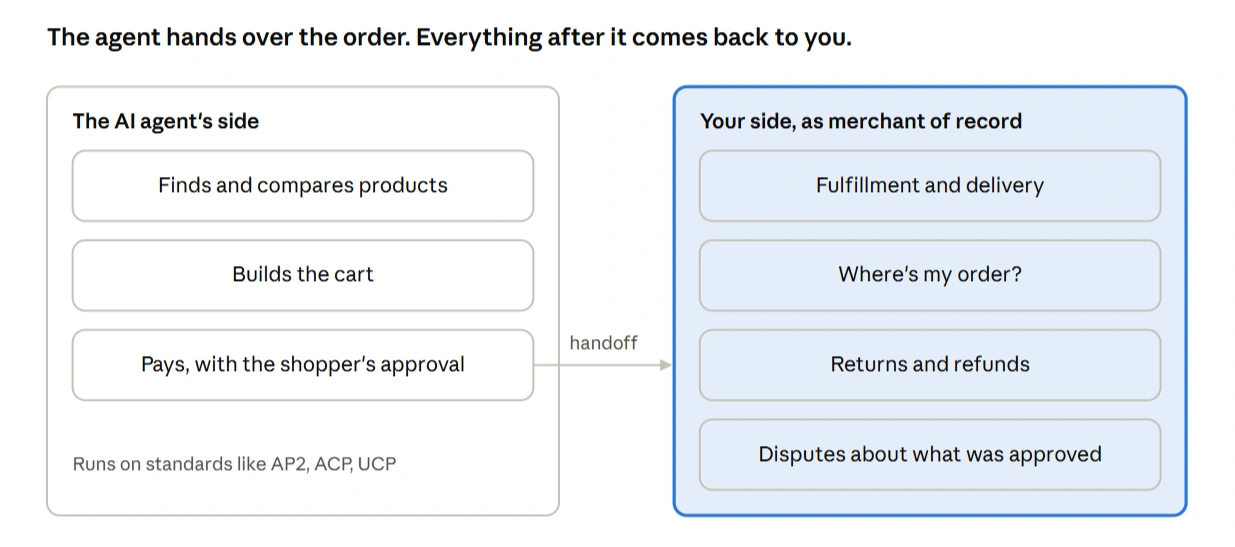
That's the side of agentic commerce that gets less attention. Agentic commerce is a shopping model where an AI agent searches for products, compares options, builds the cart, and, with the buyer's permission, completes the purchase. The agent can take over the purchase. It can't take over the customer. When something goes wrong, the call, the chat, or the dispute still comes to the merchant, often about an order your service team never saw the customer place.
Agentic commerce standards hand the after-sale back to you
Emerging agentic commerce standards, including OpenAI and Stripe's Agentic Commerce Protocol (ACP), Google's Universal Commerce Protocol (UCP) and Agent Payments Protocol (AP2), are making it easier for AI agents to complete purchases with customer authorization. But they don't remove the merchant's responsibility for fulfillment, returns and customer support.
Customers, however, may see things differently. In a March 2026 Forrester survey of 406 regular answer-engine users in the US and UK, 45% said they would blame the AI platform if a purchase went wrong, compared with just 17% who would blame the brand. Yet it's the merchant that will often have to resolve the issue.
Why agentic commerce is harder on customer service than it looks
Agentic commerce introduces new types of customer service requests that existing systems may not be equipped to handle.
Orders without a customer visit. When an AI agent completes a purchase on the customer's behalf, there may be no browsing history or website session for the service team to refer to. The order exists, but the context behind the purchase may be missing.
Disputes over what the agent purchased. A customer may have authorized the payment but not the exact product the agent selected. This creates a different kind of dispute, where the question is what the customer actually approved. Traditional evidence, such as IP addresses and device information, may not be enough to resolve it (Checkout.com).
AI agents contacting customer service. Instead of asking about an order themselves, customers may rely on their AI agents to retrieve updates. Shopify already supports this through its Order MCP, allowing agents to access order information directly. That makes the accuracy of the information available to these agents just as important as what a human service representative sees.
Give customer service agents access to shopping-agent records
When a customer contacts support about an AI-placed order, CRM notes and chat history alone may not provide enough context. Service agents also need access to the original purchase instructions, approval records and order details to understand what happened and resolve the issue. That requires four things:
- Connect orders to customer records. Store the order ID, shopping-agent platform and available approval records so service teams can retrieve the transaction without asking the customer to start over.
- Keep order information current. Make sure service agents have access to the same order status and delivery updates available to the customer's shopping agent.
- Handle purchase disputes differently. When a customer says the agent bought the wrong item, check what was authorized before deciding whether the issue requires a return, refund or further investigation.
- Define when humans need to step in. Establish which refund amounts and dispute types require human approval.
Consider a customer who asks an AI agent to buy running shoes under $150, but receives the wrong size. If the service agent can access the purchase instructions and order records, it can identify the issue and initiate a return under the retailer's policy. Without that context, the customer may have to explain the purchase all over again.
What we see in retail customer service today
Kore.ai's Agent Platform, Artemis, supports retail AI agents that handle order status, delivery changes and returns, including eligibility checks and refund workflows. The platform provides visibility into agent execution, including the tools used, guardrails applied and human handoffs. Its Agent Blueprint Language (ABL) also allows enterprises to define where human approval is required.
At a global e-commerce marketplace, Kore.ai AI agents handle approximately 520,000 calls a month covering refunds, returns, item-not-received claims and disputes. About 75% of these calls are resolved without human intervention, while roughly 9% are transferred to human agents with the conversation context attached (case study).
These orders were placed by customers, not AI shopping agents. But the deployment shows how AI can already handle many of the service requests that follow a purchase. As agentic commerce grows, the next challenge will be connecting these service workflows to the shopping agent's transaction and approval records.
What remains unresolved in agentic commerce
Connecting AI-placed orders to customer records depends on the information each shopping-agent platform shares with the merchant, and that isn't consistent yet. Liability is another unresolved issue, particularly when customers dispute purchases made on their behalf. It's still unclear how responsibility will be shared between merchants, payment providers and AI platforms (Worldpay).
Adoption is also limited. Forrester found that only 14% of surveyed answer-engine users had allowed an AI agent to make a purchase independently. OpenAI also reportedly scaled back its in-chat checkout plans in March 2026 (AI Business).
But retailers don't need large volumes of agent-placed orders to encounter these service challenges. Even a single disputed purchase requires the right information and a way to resolve it.
Three questions retailers should ask before agent-placed orders reach customer service
Ask these questions of your own systems and any technology vendor, ours included.
- If a customer places an order through an AI agent, can your service team find it without asking the customer to start over?
- When a customer says the agent bought the wrong item, can you show what they originally approved?
- When a customer's AI agent requests an order update, does it receive the same information available to your human service agents?
If the honest answer to any of them is "someone would check manually", the agents are already ahead of your service desk.
Agentic commerce moves the purchase, not the customer
AI agents may change how customers discover and buy products, but retailers still have to support them after the purchase. When something goes wrong, customer service teams need access to the order details and what the customer originally authorized.
As agentic commerce grows, retailers will need to make that information available to their service agents. The goal is simple: resolve an issue without making customers explain a purchase their AI agent made on their behalf.
FAQ
1. What is agentic commerce?
Agentic commerce is a shopping model where AI agents act on behalf of customers to search for products, compare options and complete purchases with their authorization. Retailers remain responsible for order fulfillment and customer support.
2. Who handles returns when an AI agent buys the wrong item?
The retailer typically handles returns and refunds under its existing policies, even when an AI agent places the order. Responsibility for disputed or unauthorized purchases may depend on the payment arrangement and applicable policies.
3. Do AP2, ACP and UCP cover customer service?
Not directly. These protocols support different aspects of agentic commerce, including checkout, payment authorization and order management. While some support post-purchase interactions, retailers still need customer service systems to handle inquiries, returns and disputes.
4. How should customer service teams prepare for agentic commerce?
Customer service teams should have access to AI-placed order details, available purchase approval records and current order information. They also need clear processes for handling purchase disputes, refunds and cases requiring human approval.
5. Is agentic commerce happening now?
Yes, although autonomous purchasing is still emerging. Forrester's 2026 research found that 27% of surveyed answer-engine users had made purchases within an answer engine, while 14% had allowed an AI agent to buy independently. Even at this early stage, retailers need to prepare for the customer service issues these transactions may create.
Share
Tags