
Juhi Tiwari
Juhi is a Research Lead at Kore.ai, driving market intelligence, competitive insights, and analyst-facing strategy that strengthens the company’s industry positioning. She also works as a content strategist, creating deep technical content that translates complex AI concepts into clear, compelling narratives. Her work supports Kore.ai’s vision, credibility, and thought leadership across the AI landscape.
Articles by this author
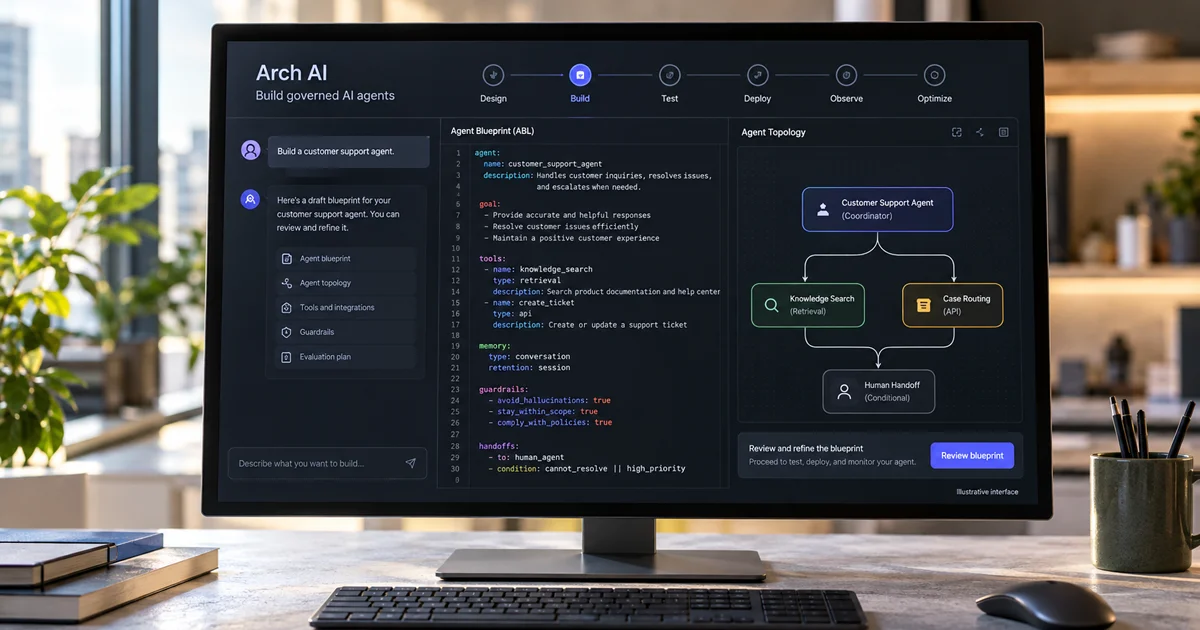
Build governed AI agents: Introducing Arch AI
Arch AI is Kore.ai’s AI solution architect for building governed enterprise AI agents. It transforms business requirements and SOPs into agent architectures, then supports development, testing, deployment, and continuous improvement. The article highlights Agent Blueprint Language (ABL), AI agent governance, runtime guardrails, observability, auditability, evaluation, and human approval, helping organizations scale agentic AI across industries while maintaining control over agent behavior and production operations.

How to ensure AI agents comply with industry regulations
AI agent compliance requires regulatory requirements to be embedded directly into the agent lifecycle and architecture. This article explores frameworks including HIPAA, GDPR, PCI DSS, FINRA, the EU AI Act, NIST AI RMF, and ISO 42001, alongside access controls, runtime guardrails, audit trails, and human oversight. Kore.ai Artemis supports governed AI through policy enforcement, observability, auditability, evaluation, and security controls for regulated enterprise AI.

Private evals are the new moat: Why every enterprise needs its own AI evaluation framework
Private AI evaluations allow enterprises to measure AI agent performance against proprietary business goals, policies, risks, and outcomes. This article explains why public benchmarks cannot fully represent enterprise AI performance and how private evaluations enable continuous testing, regression detection, governance, and quality measurement. Kore.ai Artemis integrates evaluation across the agent lifecycle using ABL, Arch AI, eval matrices, runtime traces, observability, and controlled optimization.

How to make AI agent reasoning visible and auditable
AI agent reasoning visibility helps enterprises understand, trace, and audit how AI agents make decisions. This article explores AI agent observability, reasoning transparency, reasoning drift, execution traces, runtime guardrails, and audit trails. It outlines requirements including versioned agent definitions, context tracking, drift detection, and unified traces. Kore.ai supports these capabilities through ABL, Dual-Brain Architecture, Agent Evals, Agent Insights, and runtime governance.

Why your AI harness matters more than the model you chose
An AI agent harness provides the architectural controls that make AI agents reliable, governable, and production-ready beyond the foundation model itself. This article explores agent context, memory, orchestration, tools, guardrails, evaluation, observability, and model portability. Kore.ai Artemis provides an enterprise AI agent harness through ABL, Arch AI, Dual-Brain Architecture, Model Hub, runtime governance, and centralized observability, helping organizations build adaptable, measurable, and auditable AI agents at scale.

Introducing Agent Blueprint Language (ABL): Because enterprise AI agents need more than just prompts
Agent Blueprint Language (ABL) is Kore.ai’s declarative language for defining, governing, and deploying enterprise AI agents. This article explains how ABL provides a structured, versioned artifact for agent behavior, workflows, tools, governance, and multi-agent orchestration. Written in YAML and validated through compilation, ABL supports deterministic execution, runtime guardrails, auditability, CI/CD, and observability, providing a foundation for production-ready agentic AI.